Gunhild Jensen is the owner and founder of Smiling Kitty – a Stamford CT-based cat behavior business that offers expert help and guidance to cat owners around the world. Gunhild is a certified Cat Behaviorist and holds a degree in Advanced Feline Training and Behavior from the Animal Behavior Institute (ABI) in Durham, NC. She provides guidance on all things cat, including common behavior, home needs, nutrition, leash training, declawing, cat health, and more.
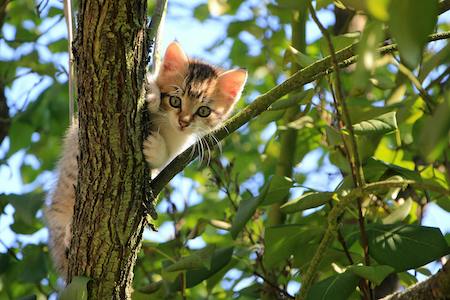
If domestic cats have access to the outdoors, you will often find them sitting in tall trees, on a garden fence, or even on the roof of your house. But what explains this special fondness for climbing? Well, as with all things cat, there is more than one reason: 1. Climbing is a hunting technique…
Tortoiseshell does not refer to a specific cat breed but to a beautiful, multi-colored coat pattern with a similar structure and color scheme to that of a tortoise’s shell. It comes in many color variations but primarily consists of ginger and black with white, orange, gold, or cream touches. Many people mistake tortoiseshell cats with…
The history of the domestic cat began about eight thousand years ago when cats first started hanging around human settlements because they provided easy access to food and shelter. Cats would eat the rodents that threatened our grain stores and sleep in our barns. In other words, the cat chose to seek out human companionship…
You know the scene. The beautiful cat bed you bought for your cat online has just arrived, and you are very excited to unpack it. Once the new bed is on the floor, however, your cat completely ignores it and chooses to curl up inside the delivery box instead. But why is that? Where does…
Calico does not refer to a specific cat breed but to a tri-color coat pattern, consisting of white, orange, and black. Calico cats can be domestic cats of any breed. The calico pattern is typically 25% to 75% white with large orange and black patches. Sometimes, patches can be cream or grey – a pattern…
You might be surprised to learn that the answer to this question is no. Cats do indeed see colors, just not all of them! Humans and cats both have two types of color receptors in their eyes: cones and rods. The cones handle vision during the day and color perception. Rods tackle what can be…
The holiday season is upon us again, so it is time to remember the potential hazards it brings to the health and safety of our feline friends. Here are a few tips: Tinsel, String, and Ribbons. Strings and ribbons are fascinating to cats and often part of a good toy. Catnip mice can have long…
The history of the domestic cat began about eight thousand years ago when cats first started hanging around human settlements because they provided easy access to food and shelter. Cats would eat the rodents that threatened our grain stores and sleep in our barns. In other words, the cat chose to seek out human companionship…
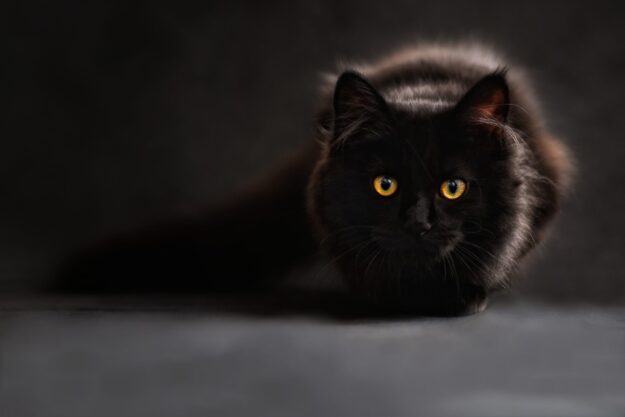
It is hard to think of a member of the feline family that has been more demonized than the black cat. Beginning in the Middle Ages, black cats became associated with evil and misfortune, and during the height of the European witch burnings in the early Renaissance period, they were seen as servants of Satan…
Historical Background The history of the domestic cat began about eight thousand years ago when cats first started hanging around human settlements because they provided easy access to food and shelter. Cats would eat the rodents that threatened our grain stores and sleep in our barns. In other words, the cat chose to seek out…