
The history of the domestic cat began about eight thousand years ago when cats first started hanging around human settlements because they provided easy access to food and shelter. Cats would eat the rodents that threatened our grain stores and sleep in our barns. In other words, the cat chose to seek out human companionship to gain important resources that they needed for their survival.
It was not until the nineteenth century, however, that cat-loving humans started breeding cats deliberately to create animals with certain appearances or demeanors. Cats were never bred for specific hunting or herding tasks the way dogs were, and consequently, the domestic cats we know today have changed very little genetically from the wild cats that first hung around our ancient farms. That explains why the differences between cat breeds are not as great as the differences between, say, a Border Collie and a Dachshund.
Scientists do not completely agree on how many different cat breeds there are in the world, so the numbers you can find vary greatly depending on your source. While Encyclopedia Britannica only lists fifteen cat breeds, The Cat Fanciers’ Association (CFA), the largest American cat registration body, recognizes forty-five different breeds as of 2023. Among these different cat breeds, many have an interesting origin story, and in this article series, I am going to feature some of them. In previous episodes, I have talked about the Maine Coon, the Siamese, the Turkish Angora, and the Sphynx. This episode will deal with the Russian Blue cat.
The Russian Blue Cat
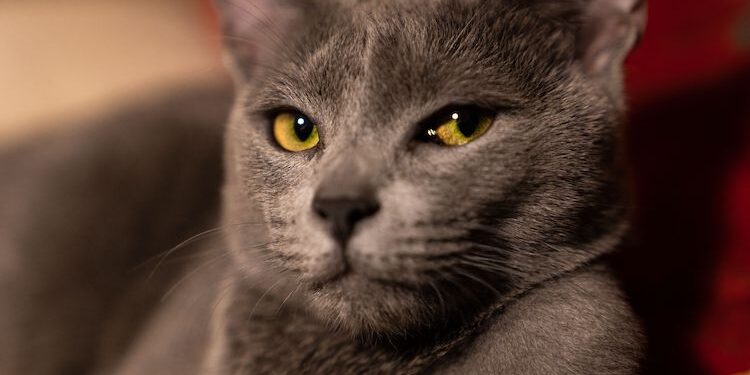
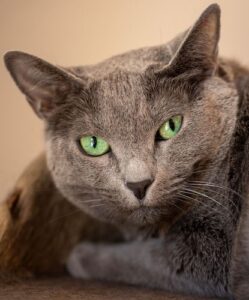
 The Russian blue is a medium-sized cat that reaches maturity at about a year old. Members of the breed have a dense double coat, so they often seem larger than they are. The coat is a shimmery blue with a silvery tint, and it is this striking color that has given the breed its name. Since the coat does not shed much, it is easy to maintain. Occasional brushing along with good nutrition is enough to keep it soft and silky. Russian Blues are not 100% hypoallergenic, but they are still a good choice for pet parents with allergies. Other striking features of Russian Blue cats include their large, wide-set eyes and their wedge-shaped head. The latter gives them a charming facial expression that creates the illusion that they are constantly smiling. The eyes are typically emerald green, but come in other colors too.
The Russian Blue is a gentle, sweet-tempered, and loyal breed. Even though they tend to form special bonds with just one pet parent, they will show affection to the entire family if their boundaries are respected. They will follow “their human” around the house and greet them at the door, but they also enjoy alone time and will actively seek a quiet, private spot where they can sleep. Russian Blues often shy away from visitors and may hide during large gatherings. If strangers, playful dogs, or overly affectionate children approach, they will prefer to stay in the safety of their hiding places until the environment has returned to normal. The Russian Blue cat is sociable on its own terms and highly intelligent. They do not mind it too much if you are away at work all day, but they will require plenty of playtime once you return home. Behavior problems in Russian Blues typically appear when the cat is under-stimulated or not allowed sufficient privacy.
 The Russian Blue is a naturally occurring breed, so we do not know its exact origin story. One theory is that the first Russian Blues lived in the wilderness and were hunted for their prized pelts. They likely stem from Archangel Island and its surrounding areas in northern Russia, which is also evident from their nickname “Archangel Cats”. Here, it is believed that Russian sailors befriended the felines sometime around the 1860s and brought them aboard their ships as companions. This could explain how the breed made its way to Great Britain and Northern Europe. Another theory is that these sleek, smiling cats are the descendants of pets belonging to the Russian royal family. The Russian Blue was favored by the czars, who gifted them to other royals, diplomats, and noblemen across the European continent. In 1875, Russian Blues were shown at one of the world’s first cat shows at Crystal Palace in London. They arrived in the United States in the early 1900s and were officially recognized as a breed in 1912.
After World War II, Russian Blues were in decline, but cat enthusiasts managed to save them. In Sweden, Finland, and Denmark, Russian Blues were crossbred with Siamese cats to produce slightly longer and more angular specimens. Together, these nations helped preserve the breed that continues to fascinate us to this day.
Here are four fun facts about the Russian Blue:
 1. According to Russian folklore, Russian Blue “Archangel” cats could chase away evil spirits. For that reason, they were often kept in the chambers of newborn children.
2. The Russian Blue’s upturned smile is also called a Mona Lisa smile, because of its similarities with the smile in the famous painting by Leonardo da Vinci.
3. Sometimes, Russian Blues are born with so-called “ghost stripes.” These are faint tabby markings that disappear as the cats mature.
4. The cat Tom from the famous cartoon Tom and Jerry, with his bright, green eyes and blue-gray color, is believed by many fans to be a Russian Blue.