
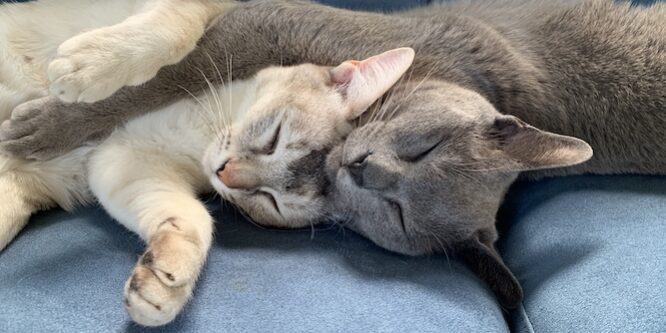
 Healthy adult cats sleep an average of 15 hours per day, and simply put, daytime sleeping is instinctual feline behavior. Cats are natural predators, and the birds and rodents they live on are both quick and elusive. Therefore, cats in the wild must work hard to meet their dietary needs. To achieve the necessary speed and finesse, they go through a complete hunting sequence—chasing, sneaking, pouncing—every time they attempt to catch or kill prey. Spending that kind of physical energy is exhausting and requires frequent sleep, so meat-eating animals (carnivores) generally sleep more than animals living on plant-based diets (herbivores). For cats, sleep primarily happens during the day because they belong to a specific group of carnivores known as crepuscular predators. They are animals that hunt during the twilight hours at dusk and dawn when their prey is equally active. They spend the daylight hours in between in a restful state, conserving their energy for the upcoming hunt. As a species, cats—whether they sleep in the wild or cuddle up on our sofas—are all hardwired to this same internal clock, explaining why a lazy, well-fed house cat still engages in extensive daytime napping.
Cats have also adapted to life in hot climates by using sleep to keep themselves cool. Frequent naps help regulate body temperature, so you could argue that cats have inspired the daily siestas of people in hot countries such as Italy and Spain.
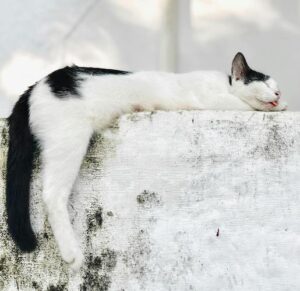 Cat sleep can be divided into two types. Type 1 is called slow-wave sleep (SWS) and makes up about three-fourths of their sleep time. It is a shallow state of rest in which the cat will doze in a ready position. The sense of smell and hearing will be “on”, the eyelids slightly parted, and the ears or tail may occasionally twitch. Peaceful but poised, the cat is ready to react instantly: to pounce on prey or to swat intruders. These famous “catnaps” usually last 15-30 minutes. Type 2, the other one-fourth of a cat’s sleep time, is a deep sleep state where the cat is truly “out” and often reaches Rapid Eye Movement (REM) sleep. Paws, ears, tail, and whiskers can tremble, indicating that the cat is likely dreaming. This deep sleep usually comes in five-minute increments, broken up by dozing.
Senior cats and kittens may spend up to an average of 20 hours sleeping. Newborn kittens typically sleep 24 hours a day, growing while they nurse and nap. As a kitten matures, the amount of sleep required diminishes until it reaches the average of 15 hours a day in adulthood. In their senior years, cats’ need for restitution increases again, just like it does in humans. Furthermore, cat behavior is highly adaptable, and most housecats will adjust their sleeping patterns to follow a schedule that allows them quality time with their favorite people.
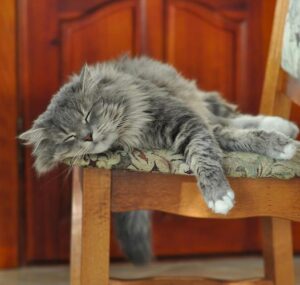 It is also important to note that cats tend to nap more if they feel unwell or bored. Cats are notorious for hiding symptoms of serious illnesses from us until it is too late for treatment. An increase in sleep time is often our first warning sign that something is amiss. Similarly, a bored cat is prone to several behavior problems that can be difficult to solve without the assistance of a cat behaviorist. To keep our feline friends happy and healthy for many years to come, we, as loving cat owners, should therefore pay attention to any changes in their sleeping habits—no matter how insignificant they might seem.