
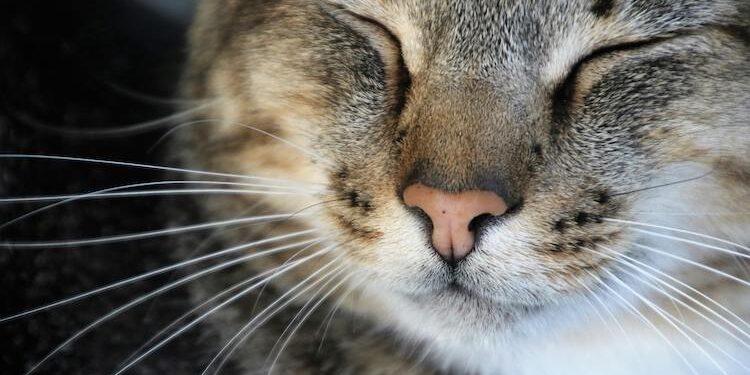
 A cat’s body language is much more subtle and silent than the body language of dogs and other household pets. When dogs are ill, for instance, they might whimper, become droopy-eyed, or hang their tails, but cats are notorious for hiding any symptoms of pain. For that reason, learning how to read cats properly is extremely important – both for their health and for the bond we wish to form with them.
What are whiskers?
A cat’s whiskers are among the most sophisticated hairs in the animal kingdom. In terms of appearance, they are coarser and thicker than regular hair, with roots that extend three times deeper. They are strategically located on the cheeks, above the eyes, on the chin, on the forelegs, near the ears, and above the upper lip. What makes whiskers so unique is their sensitivity. In fact, we can compare them to our human fingertips, and they serve an equally important function. They are highly developed sensory tools that help cats feel and navigate their environment. As such, they provide input crucial to the cat, like the antennae of an insect. Whiskers can detect subtle changes in air currents and send information to the brain about the size, shape, and speed of nearby objects. This unique ability aids cats in keeping their balance, finding the best path forward, jumping, climbing, and hunting for prey.
How do cheek whiskers communicate cat emotions?
A cat’s cheek whiskers are more than incredible navigation tools. Cats also utilize them to express their emotions, so they must be considered whenever we attempt to read a cat’s body language. The exact length and pattern of the cheek whiskers vary with breed. Most cats have 12 of them, arranged in four rows on each side of their face. Let’s have a look at what your cat may be telling you with the help of their cheek whiskers:
 “I’m friendly!” When a cat is happy, contented, or relaxed, whiskers are kept in a neutral position, slightly to the side.
“I’m interested, or I’m hunting!” When a cat’s interest is engaged, whiskers pull forward and fan out, and the mouth is closed with loose lips. The muzzle appears slightly plumped up. Whiskers also fan out and move forward when a cat is hunting, whether in the wild or in your living room.
“I’m fearful, anxious, or stressed!” When a cat experiences an increase in fear, anxiety, or stress levels, the whiskers begin to move slightly backwards. In cases of severe stress, they pull back as far as they can go, while the ears move further to the side. Whiskers and ears are a dynamic duo in cat body language.
“I’m aggressive!” Whiskers and ears also clue you in on a cat’s aggression levels, and you should always heed the warning! Whiskers pulled back tightly to the face signal aggression. In the case of offensive aggression, whiskers and ears point forward. For a full read, be sure to notice the ears, most likely pulled back, as well as the eyes, body, and tail position.
“I’m in pain!” As mentioned before, cats are experts at hiding symptoms of pain, but the cheek whiskers can give you a clue. If your cat is in pain, they will move from sideways to forward, causing the cheeks and muzzle to flatten. Never hesitate to call your vet if you think something might be wrong.
 Understanding what your cat is communicating helps improve the loving bond between the two of you, and hopefully, you have enjoyed reading this article about whisker language. Before I finish, however, I would like to share some of my personal experience dealing with whisker-related issues. Working as a cat behaviorist, I meet cats that are the victims of whisker abuse more often than I would like to. Mild cases tend to be caused by children, who still need to learn that a cat’s whiskers are not a toy for them to pull or yank at. More severe cases, on the other hand, typically involve adult cat owners, who have decided to cut their cat’s whiskers, either because they find them to be too long or don’t like the fact that the whiskers are not the same length. You should NEVER cut your cat’s whiskers. Not only is it extremely painful for the cat due to all the nerve activity in the whiskers, but it also impairs a cat’s ability to navigate their world safely. It makes them disoriented and fearful, and will cause them to develop unhealthy behaviors, such as fear aggression, contact avoidance, eating disorders, and potentially life-threatening elimination problems. Please keep your children and your scissors away from your cat’s whiskers, so that you may instead enjoy the story these magnificent hairs are telling you.